

Summer changes everything. The back door opens more, trips get longer, and your dog is right there for all of it — the patio dinners, the camping weekends, the beach days, and everything in between. What doesn't change is that they still need a good place to rest.
The problem is most beds aren't designed for any of this. Fabric that traps heat. Fill that stays damp. Covers that look fine after one wash and fall apart after four. Outdoor conditions are harder on materials than indoor ones, and a bed that works beautifully in a living room can fail fast once it meets real use.
This guide walks through what actually matters when choosing a bed for outdoor use — what to look for in fabric, fill, and construction, and which bed makes sense for which scenario. Whether your dog spends afternoons on the patio, joins you camping, or follows you to the beach, there's a right option. Here's how to find it.
Start With the Fabric
Fabric does most of the work outdoors. It takes the sun, the moisture, the dirt, and the repeated cleaning. Get this wrong and nothing else matters.
For patio and general outdoor use, look for water-resistant fabric with UV protection. Water resistance keeps surface moisture from soaking in after rain or a damp dog. UV protection matters more than most people expect—prolonged sun exposure will fade and degrade fabric that isn't rated for it, often within a single season.
For beach, lake, and water-adjacent use, the bar is higher. You want something that can be hosed off completely—cover and pad together—and dries fast. Ripstop nylon with UPF rating handles this well. The tight weave resists snags, and the finish sheds both water and sand without absorbing either.
Solution-dyed acrylic is worth knowing about for patio-specific use. The color is baked into the fiber during manufacturing rather than applied on top, which means it resists fading at a fundamentally different level than surface-dyed fabric. It's also mildew-resistant and bleachable—genuinely useful when a bed lives outside season after season.
A faux-linen polyester sits at a different point on the spectrum: more refined-looking for a patio setting, water and UV-resistant, and easy to maintain. Not a hose-off option, but well suited for covered patios, sunrooms, or outdoor spaces where the bed stays relatively protected.

What to look for: water resistance, UV protection, and a surface that cleans easily.
Fill and Construction Matter Too
Even with great outer fabric, fill matters. Standard foam holds up fine indoors, but outdoors it absorbs moisture from a wet dog, morning dew, or a cover that didn't fully dry before going back on. Once foam is saturated, it takes a long time to dry, which is why outdoor beds are built around different fill materials entirely.
![[ALT TEXT: Recycled polyester fiber fill inside an outdoor dog bed]](https://cdn.shopify.com/s/files/1/0626/9429/3587/files/Fiber_Insert_close.jpg?v=1780602557)
Recycled polyester fiber fill performs well outdoors for most use cases. It's resilient, holds its loft through repeated washing, and dries reasonably quickly when the cover is removed. For beds that stay on a covered patio or are brought inside at night, this works well.
![[ALT TEXT: Air foam pad from the Body Glove Sun and Sand Tough Mat]](https://cdn.shopify.com/s/files/1/0626/9429/3587/files/Sun_Sand_Mat_Green_foam.jpg?v=1780602557)
Air foam is the right choice when the bed is genuinely getting wet. Unlike traditional fill, air foam doesn't absorb water — it lets air and moisture pass through, which means it dries fast and doesn't hold odor. For beach days, lakeside camping, or any situation where a soak is likely, air foam is the material that actually solves the problem.
![[ALT TEXT: Body Glove Fold and Go Pet Cot set up outdoors at a campsite or beach]](https://cdn.shopify.com/s/files/1/0626/9429/3587/files/Fold_Go_Cot.jpg?v=1780602557)
Elevated cots remove fill from the equation entirely. A stretched fabric surface over a frame keeps the dog off the ground, allows airflow underneath, and eliminates the damp-fill problem altogether. For camping and travel use, a cot that folds flat and packs into a carrying case is practical in a way most beds simply aren't.
Construction details worth checking: hidden zippers (exposed metal hardware rusts outdoors), reinforced seams (stress points break down faster outside), and machine-washable covers. A cover that has to be hand-washed or dry-cleaned isn't realistic for outdoor use.
Match the Bed to How You Actually Use It
Not every outdoor bed needs to do everything. The right choice depends on where the bed lives and what it has to handle.
Patio and yard. This is the most forgiving scenario — the bed has some shelter, it's not getting submerged, and you have time to let it dry between uses. Look for water-resistant fabric, UV protection, and a washable cover. Fit and aesthetics matter more here because the bed is part of your outdoor living space, not just a utility item.
Camping. Portability becomes a real factor. A bed that rolls up, packs flat, or comes with a carrying case is much easier to bring than one that doesn't. Waterproofing matters more here because there's no controlled environment — ground moisture, rain, and dew are all possibilities. Elevated cots earn their place in this category by lifting the dog off cold or damp ground entirely.
Beach and water. This is the hardest scenario for any bed. Sand works its way into everything, moisture is constant, and salt accelerates degradation in materials not rated for it. Hose-off construction — a cover and pad that can both be rinsed clean and dried quickly — is the only practical solution. Air foam fill and ripstop nylon covers were designed specifically for this kind of use.
Travel and multi-use. If the bed moves between the car, the hotel, a friend's house, and the backyard, lightweight and packable matter as much as durability. A cot with a folding frame is genuinely portable. A flat mat that rolls or folds fits in a gear bag. The tradeoff is comfort level — beds optimized for portability offer less cushioning than a full-fill patio bed.

Patio use: prioritize UV protection and washability.

Travel and water use: prioritize portability and fast drying.
When the Bed Has to Work Everywhere
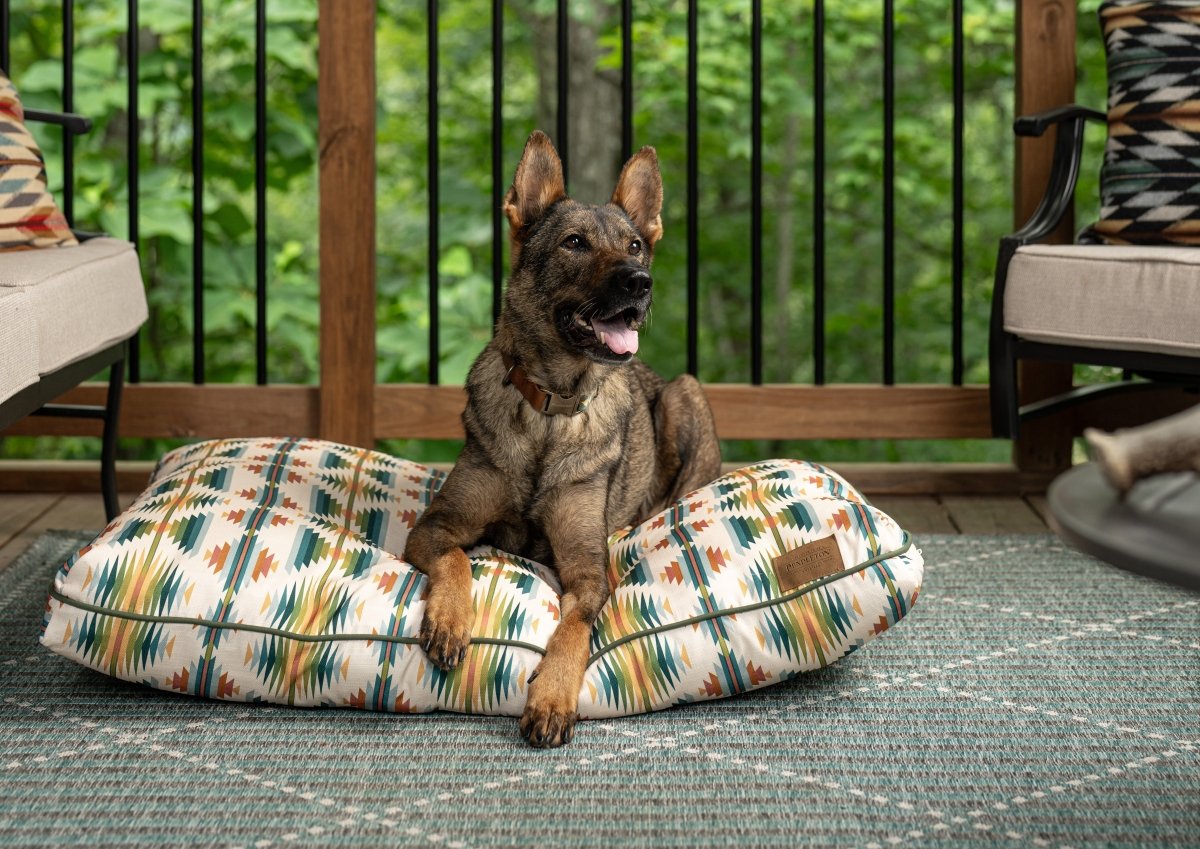
Some beds are designed for a specific use case. The Pendleton All Season Pet Napper is designed to work in all of them — indoors, outdoors, in the car, and everywhere a patterned Pendleton bed looks at home.
The fabric is a low-maintenance faux-linen polyester with water and UV resistance, chosen for its durability and easy care as much as its appearance. The cover is removable and machine washable. Fill is 100% recycled polyester fiber.
It's an indoor/outdoor bed in the truest sense — not a compromise between the two, but a bed that transitions between contexts without asking you to think about it. Three Pendleton patterns are available, each with the brand's recognizable heritage aesthetic and suede Pendleton label.

The Pendleton All Season Pet Napper. Water and UV-resistant fabric, recycled fill, three iconic patterns.
A Few Things Worth Knowing Before You Buy
When in doubt, size up. Outdoor beds are often used by dogs who sprawl more than they would inside. If your dog is between sizes, choose the larger option. A bed with a little extra room is always better than one that's too small.
Think about cleaning before you need to. A bed that requires the cover to be removed, hand-washed, and air-dried for 24 hours isn't practical when it's living outside. Machine-washable covers and hose-off construction are features worth paying for, not just nice-to-haves.
UV ratings degrade over time. Even UV-stable fabrics will eventually show wear in high-sun environments. Storing the bed inside or under cover when not in use will extend its life significantly.
For chewers, construction matters more than fill. Heavy-duty ripstop canvas with reinforced seams holds up to scratching and light chewing far better than standard polyester. It won't survive a determined chewer, but it will outlast a typical indoor fabric by a significant margin outdoors.
Find the Right Bed for Your Summer

Patio afternoons, camping weekends, beach days, or just a yard that gets more use in June than any other month. There's a bed for each of those scenarios — and now you know what to look for in each one.