

America at 250 · Made in Prosperity, SC
The Carolina Textile District & the Story of Carolina Pet Company
How a 1925 schoolhouse in the South Carolina woods kept the needle and thread moving — from cotton mills to cat beds.
As the United States marks its 250th birthday this year, a lot of the celebrating will rightly focus on the big stories — the founding documents, the famous names, the battlefields. But the American story has always been just as much about the things people made with their hands, in ordinary places, far from the spotlight. It's about a country that built things.
We think about that a lot here in Prosperity, South Carolina, because our factory sits inside one of those ordinary places — a building that has been making things, in one form or another, for the better part of a century. To understand how a pet company ended up in the woods off Highway 391, you have to understand the textile district that grew up around it, and what it took to keep the lights on when nearly everyone else's went dark.
1876–1930 · The textile boom
Cotton, mills, and the New South
For most of the nineteenth century, the South Carolina upcountry was cotton country — fields, sharecroppers, and tenant farmers spread across the rolling Piedmont between the Broad and Saluda Rivers. After the Civil War, a new idea took hold: instead of shipping raw cotton north to be spun into cloth, why not build the mills here, where the cotton grew?
That idea became a movement. Beginning with the Piedmont Mill near Greenville in 1876, the Carolinas filled up with cotton mills at a staggering pace. By the 1890s, South Carolina had dozens of them, and by 1900 the state trailed only Massachusetts in cotton-textile production. The upper Piedmont — anchored by Greenville and Spartanburg — became known as the textile center of the South, and eventually of the world.
Newberry County was very much part of this story. The Newberry Cotton Mill began operating in 1884, one of the early steam-powered factories in the state. The Mollohon Mill followed in 1902, and the Oakland Mill in 1912. These mills didn't just employ people; they built whole worlds around themselves — rows of mill houses, churches, schools, ballfields, company stores.

It would be dishonest to romanticize all of it. The work was hard, the hours were long, and the early mills ran heavily on the labor of women and children. When the photographer Lewis Hine traveled the South in 1908 to document child labor, he stopped at the Mollohon Mill right here in Newberry and photographed the young doffers and sweepers working the spinning frames. Those images are part of our region's history too, and they're part of why the country eventually changed its laws. The American story of making things includes the reckoning with how those things were sometimes made.

1925–1990s · One building, many lives
The building in the woods
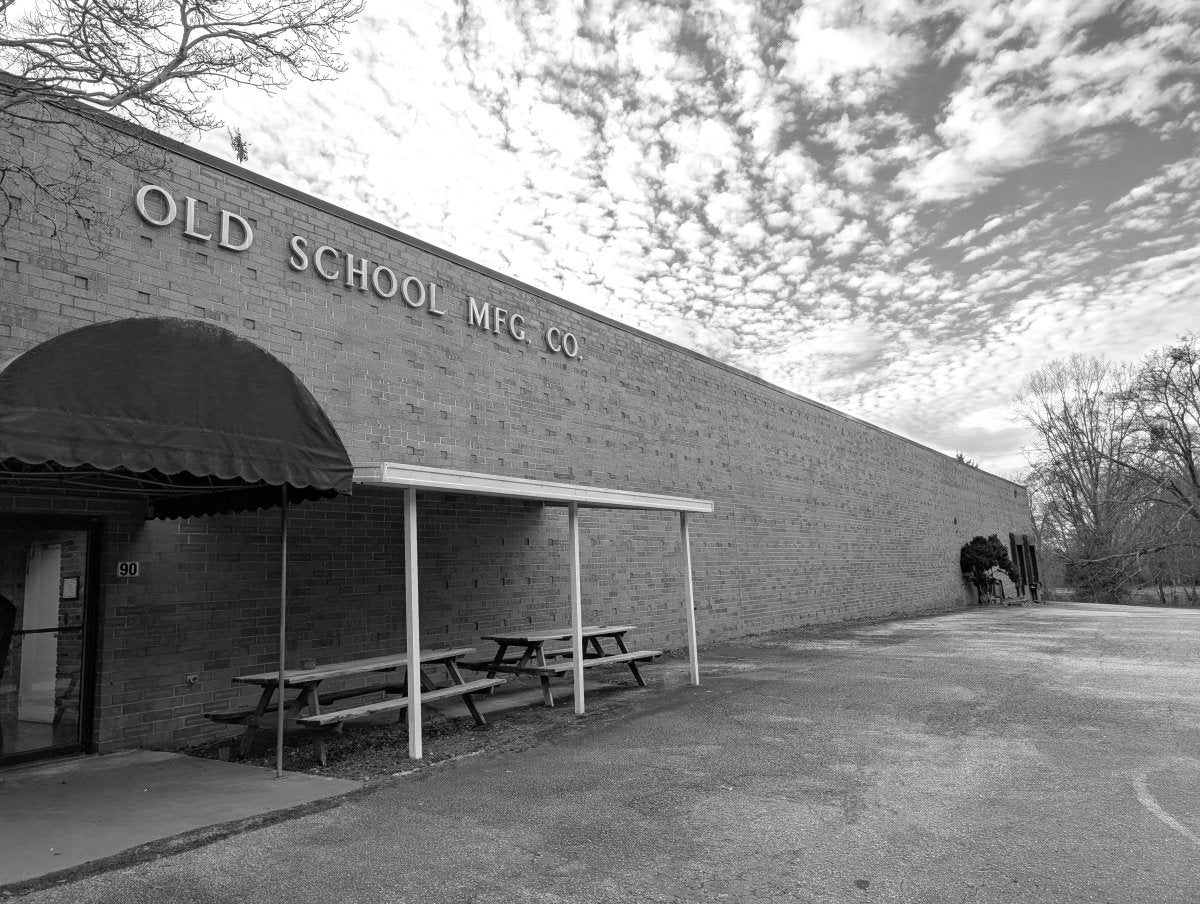
Our own building started its life not as a mill but as a school. The old O'Neal School in Prosperity was erected in 1925 — there's still a bronze plaque in the foyer that says so.
When the school eventually closed, the building found a second life the way so many Southern buildings did: it became a sewing operation. Locals simply called it "the Sewing Room." Over the years it housed Old School Manufacturing, then Setlow and Sons, then Dickie's — cut-and-sew businesses that came and went as the building was renovated and expanded into a sprawling manufacturing space. This was the textile district in its later, scrappier phase: not the great spinning mills of the boom years, but smaller shops stitching finished goods, hanging on.
And hanging on got harder. Starting in the 1970s, foreign competition and falling trade barriers began pulling the floor out from under American textiles. One by one, the mills of the Piedmont closed — devastating to towns where a single mill was often the only employer. In Newberry, the Oakland Mill was the last of the old textile mills to shut its doors, the final chapter of an industry that had defined the county for a hundred years.
1993–2007 · The pivot to pets
A cat, an air conditioner, and a new line of work
By all rights, the building in the woods should have gone quiet for good. Instead, it pivoted — into pets.
In the early 1990s, a local businessman named John McAllister was manufacturing air-conditioning filters in the old school building. He noticed something odd: cats kept wandering in and curling up on the filter pads. Being an observant man, he designed a cat bed out of the same material, patented it, and in 1993 began making the PurrPadd® right there in Prosperity. A four sided version, the KittyKuddler®, followed in 1995.
The cat beds sold. When McAllister decided to retire, Christian Theodosiou purchased the business and the building in 2001. A few years later he brought in partners, and in 2007 the operation became the Carolina Pet Company we know today — adding dog beds to the lineup while keeping the original cat beds in-house.
Today · Still at the machines
Still making things in Prosperity

The cut-and-sew floor. Where PurrPadd® cat beds and our Renewed Pet Bed Collection are cut and sewn by hand in Prosperity, SC.
That brings us to the company we are today. In order to grow and diversify our product lines, much of what Carolina Pet sells arrives as sewn goods from trusted partners overseas, and our team finishes and fills those beds right here in the old school building — mainly stuffing them, with fill made from recycled plastic bottles. The cat beds that started it all are still sewn in-house.
We've also found ways to keep more of the work — and more of the material — close to home. The Carolina Piedmont is still dotted with fabric manufacturers, the descendants of the old textile district, and we buy their deadstock: quality fabric left over from other production runs that would otherwise go to waste. We sew it into beds ourselves, right here in Prosperity. That's the heart of our Renewed Pet Bed Collection — American-sewn beds made from local cloth that already exists, given a second life.
 PurrPadd®. The cat bed that started it all — still made in-house.
None of this looks like the textile district of 1900. There are no smokestacks, no mill village, no whistle calling the shift to work. But stand inside the building and the through-line is obvious. This is still a place in the Carolina Piedmont where people sit down at machines and stitch things together — where the needle and thread that built this region never quite stopped moving, even after the great mills fell silent.
America at 250
That feels like the right thing to celebrate as the country turns 250. America's story isn't only written in capitals and on monuments. It's written in places like a 1925 schoolhouse in the South Carolina woods that has stood the test of time and became a sewing room, then a cat-bed shop, and then a company making things all over the world, but still keeping its roots firmly planted in South Carolina.
We're proud to be a small part of that long, stubborn, hopeful tradition. Here's to the next 250.